12 Apartment Kitchen Ideas That Make a Small Space Work Hard
An apartment kitchen is not just a small kitchen. It comes with rules you did not write, walls you cannot move, and neighbors on the other side of them. It also has to do everything a house kitchen does, in a room that might also be the hallway, the laundry corner, and the place where the Wi-Fi router lives.
This post is for renters. It does not assume you own the kitchen, and it does not tell you to drill holes in a wall you do not own. It tells you what you can do without permission, what you need written permission for, and how to get your deposit back. That is the difference between an apartment kitchen post and a small kitchen post. For general small-kitchen storage, see our small kitchen storage ideas guide: https://homeventra.com/small-kitchen-storage-ideas/ This post is about the apartment part.
What Needs Landlord Permission, and What Does Not
Read your lease first. Every lease is different, and your lease always wins over any blog post, including this one. Look for the sections on alterations, painting, nail holes, and move-out condition. Search for the words “alterations,” “modifications,” and “improvements.” That section tells you more than any general guide can, because it is the one that is legally binding for your specific unit.
With that warning, here is the general rule that most leases follow in the United States. If a change can be fully undone in under an hour with basic tools, it is almost always safe. If it involves drilling, cutting, plumbing, wiring, or anything permanently attached to the structure, it is a no, or a “landlord has to say yes first.” When in doubt, ask. A quick email can save you a deduction later.
Usually no permission needed (fully reversible):
- Freestanding furniture, rolling carts, and freestanding shelves
- Removable hooks, Command strips, suction hooks, and over-door racks
- Tension rods for curtains, and curtains themselves
- Swapping cabinet knobs and handles, if you keep every original knob and screw in a labeled bag
- A rug, a runner, and textiles
- Small appliances, a kettle, a blender, and a toaster
- Plants, jars, and countertop storage
Usually needs written permission (ask first, in writing):
- Painting walls, cabinets, or doors
- Drilling holes in walls, ceilings, or cabinets, including for shelves and a TV bracket
- Installing wallpaper, including peel-and-stick wallpaper in some leases
- Changing light fixtures, including replacing a pendant
- Installing a shelf that needs wall anchors
- Any change to plumbing or electrical work
Never do without permission, and usually never do at all in a rental:
- Removing a wall, even a wall you are sure is not load-bearing
- Any plumbing work beyond a screw-on shower head or a faucet aerator
- Any electrical work, including adding outlets or changing wiring
- Installing built-in cabinets, built-in shelves, or permanent lighting fixtures
- Changing the flooring
Get permission in writing. Email or text counts as a record, but email is better, because it is easier to find later. If your landlord says yes on the phone, follow up with an email that says “Just confirming what we agreed on the phone: I can paint the kitchen cabinets white, and I will repaint them to the original color before I move out.” Keep that email. If your landlord says yes to one type of upgrade, it does not mean they have consented to others. Ask separately for each change.
The Deposit-Safe Checklist
A security deposit is money you pay upfront to cover unpaid rent or damage beyond normal wear and tear. At the end of your lease, your landlord can inspect the unit and deduct for repairs that fall into that category. Whatever is left over should be returned to you. Landlords are often required to give you an itemized list of any deductions, and some are required to include receipts or estimates. Rules vary by state and city, so check your local tenant rules or a local tenant resource for specifics where you live.
Landlords generally cannot deduct from your deposit for normal wear and tear. That includes minor scuffs on walls, small nail holes from picture hangers, loose door handles from regular use, and repainting after a normal tenancy. They can usually deduct for damage beyond that, including large holes or many anchor holes, burns, broken fixtures, excessive dirt, and missing items that came with the unit.
Use this checklist from the day you move in to the day you move out.
Move in:
- Photograph every wall, cabinet, worktop, and appliance, including close-ups of any existing damage. Email the photos to yourself so they have a date.
- Note the existing paint color, and keep a note of it. If you repaint, you will need to repaint it back.
- Keep every original knob, handle, and screw in a labeled bag. Do not throw them away.
- Read the lease sections on alterations and move-out condition, and keep a copy.
While you live there:
- Fill small nail holes with spackle when you take a picture down, let it dry, sand lightly, and touch up with matching paint if your lease allows it. Do not attempt to patch and paint a large hole yourself if your lease restricts it. If it is a picture-hanger hole and it is small, that is not excessive wear and tear. If it is a bracket to support a TV, those holes are excessive, and you will be charged for the repair.
- Keep a record of every permission you get, in writing, with the date.
- Keep receipts for anything you buy for the kitchen, so you can prove what you bought and what you are taking with you.
Move out:
- Restore everything to its original condition. Put the original knobs back. Take down removable hooks and shelves. Repaint any wall you painted, if that was the agreement.
- Clean the kitchen thoroughly, including the oven, the fridge, and the cabinets.
- Photograph everything again, in the same way you did on move-in day.
- Ask for an itemized list of any deductions, and for receipts or estimates if your state requires them.
If you are unsure about hanging something heavy, ask your landlord before you drill. A quick email can save you a deduction later. That is the whole deposit-safe rule in one sentence.
Three Real Apartment Layouts, With Measurements
An apartment kitchen is usually one of three layouts. Measure yours, work out which one it is, and then use the measurements for that layout. Do not buy furniture until you have measured.
1. Galley: Two Facing Runs
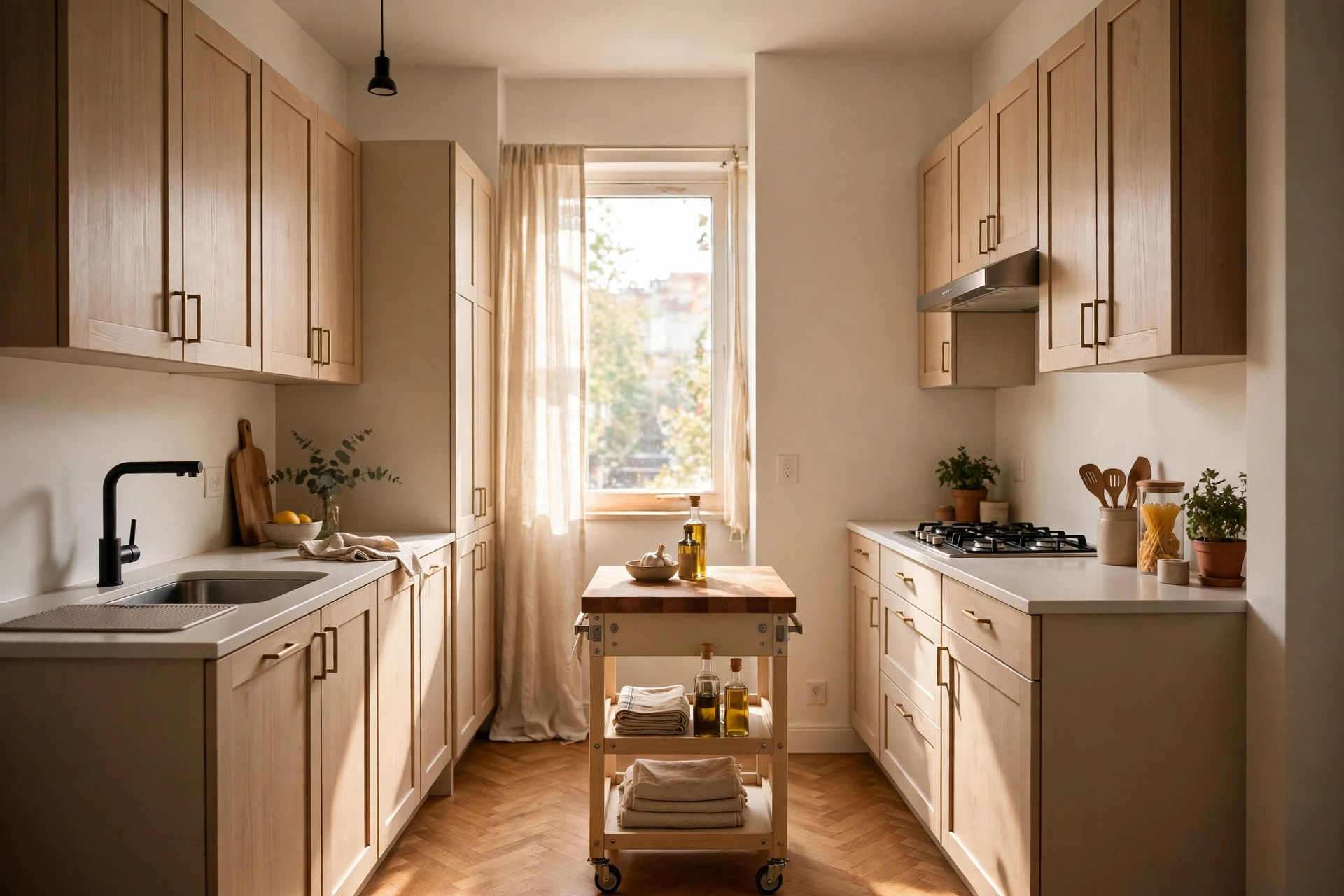
A galley kitchen has two facing runs of cabinets, with a walkway between them. It is the most common apartment layout, and it is a gift, not a problem. Two facing runs mean everything is within reach and there is no wasted corner.
Measurements that matter:
- Walkway between the two runs: 90 cm to 120 cm (about 36 to 48 inches) is comfortable. Less than 90 cm feels cramped. More than 120 cm wastes space.
- Worktop height: about 90 cm (36 inches) is standard. If your worktop is lower, a thick chopping board can raise the working height.
- One clear worktop stretch: at least 60 cm (24 inches) uninterrupted, for chopping and prep. Protect that stretch. Do not put a drying rack on it.
How to make it work: Keep one run for cooking and the other for prep and storage. Resist filling the middle with a table that blocks the walkway. Use the wall above the worktop for open shelves or a rail, because the walkway is too narrow for extra furniture. A narrow rolling cart, about 30 cm wide, can sit at the end of a run and roll out when you need it. Keep the top of the fridge and the top of the wall cabinets working with baskets for bulky, light things.
2. One-Wall: Everything on One Wall
A one-wall kitchen has all the cabinets, the sink, and the cooker on a single wall. It is common in studios and small one-bedroom apartments, and it is the hardest layout to cook in, because there is no triangle. Everything is in a line.
Measurements that matter:
- Total run length: most one-wall kitchens are 240 cm to 360 cm (about 8 to 12 feet) long. If yours is shorter than 240 cm, you will need to be strict about what lives on the worktop.
- One clear worktop stretch: at least 60 cm (24 inches) uninterrupted, for chopping and prep. In a one-wall kitchen, that stretch is usually between the sink and the cooker.
- Space behind a chair: at least 75 cm (30 inches) behind a chair at a table, and 90 cm (36 inches) for a walkway behind it. If you do not have that space, use a fold-away table instead of a permanent one.
How to make it work: Zone the run by job, not by size. Put daily things at hand height, weekly things higher, and rarely-used things highest of all. Use a rolling cart as a second worktop that can move to where you need it. Use the wall for storage, with removable hooks and a magnetic strip for knives, because you have no other wall to use. Keep the worktop clear except for three things: a plant, a board, and one beautiful everyday object. In a one-wall kitchen, a clear worktop is not a styling choice. It is the only way to cook.
3. Studio: The Kitchen Is Also the Living Room
A studio apartment has no separate kitchen. The kitchen is visible from the sofa, and it is part of the living room. That changes the job: the kitchen has to look like part of the home, not like a cupboard.
Measurements that matter:
- Distance from the cooker to the sofa: if it is less than 2 meters (about 6.5 feet), cooking smells will reach the sofa. Use the extractor every time, open a window while you cook, and keep a lid on the pan.
- Table size: a small drop-leaf table, about 60 cm by 90 cm when open, seats two for dinner and folds away for cooking. A wall-folding table does the same job and takes no floor space when it is folded.
- Worktop stretch: at least 60 cm (24 inches) uninterrupted, for chopping and prep, as in the other layouts.
How to make it work: Match the kitchen to the living room. Use the same wood tones and the same calm colors, so the whole flat feels bigger. Open shelving styled like a living-room shelf helps more than a closed door ever would. Choose quiet tools for shared walls: a hand whisk, a quiet kettle, and a chopping board with a damp cloth underneath keep the peace. A noisy blender at 7 am is a neighbor problem in a flat, and it is also a problem for anyone sleeping on the sofa.
Storage Without Drilling a Hole
Tension rods, suction hooks, magnetic strips, and over-door racks add storage without a single drilled hole. In a rented flat, that is not a compromise. It is the whole strategy, and it travels with you to the next place.
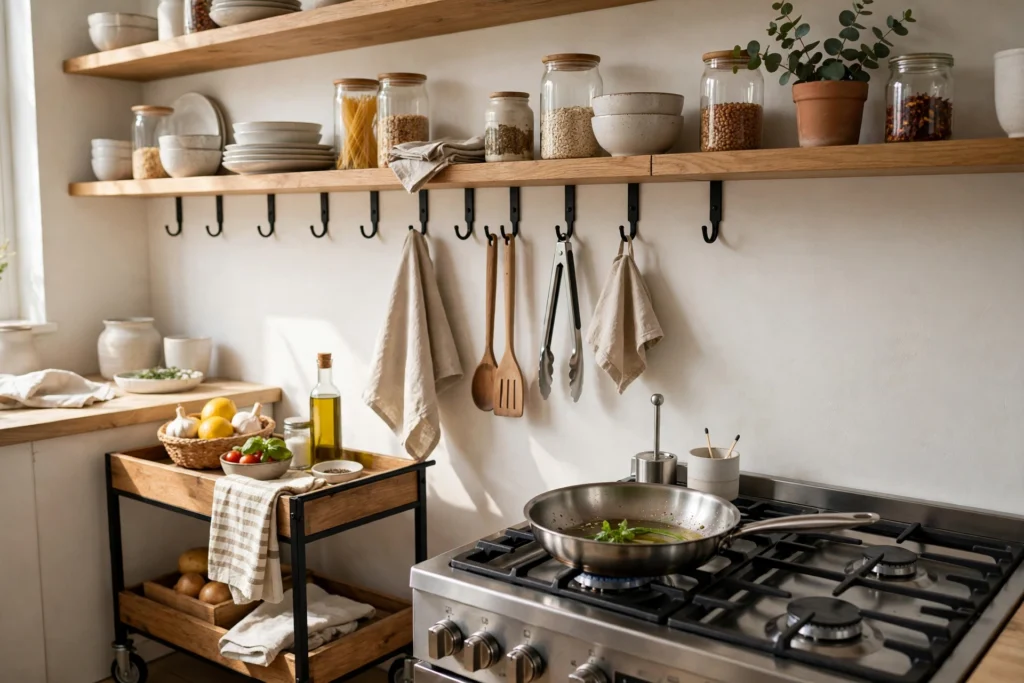
A rolling cart is the extra cupboard you can move. A narrow cart beside the cooker or fridge holds oils, spices, or cleaning supplies, rolls out of the way when you need the floor, and doubles as extra worktop when guests come.
Zone the cupboards by job, not by size. Put daily things at hand height, weekly things higher, and rarely-used things highest of all. Apartment cupboards are small, so one messy cupboard wastes a quarter of your storage. Zoning stops that.
Keep the top of the fridge and cabinets working. Baskets on top of wall cabinets hold bulky, light things: baking trays, picnic gear, the slow cooker. It is dead space in most flats, and in an apartment no space should be dead.
Living With a Kitchen That Is Also a Room
Make the kitchen look like part of the home, not a cupboard. In a studio or open-plan flat, the kitchen is visible from the sofa, so matching it to the living room makes the whole flat feel bigger.
Cook smells out, or the sofa smells like dinner. A small flat has nowhere for cooking smells to hide. Use the extractor every time, open a window while you cook, and keep a lid on the pan. It is a habit, not a purchase, and it changes how the flat feels.
Choose quiet tools for shared walls. A noisy blender at 7 am is a neighbor problem in a flat. A hand whisk, a quiet kettle, and a chopping board with a damp cloth underneath keep the peace, and keep you on good terms with the people next door.
A fold-away table beats a permanent one. A wall-folding table or a small drop-leaf table seats two for dinner and vanishes for cooking. In an apartment, furniture that folds away is not a compromise. It is how one room does two jobs.
What to Ask Your Landlord: A Short Email You Can Copy
If you want to ask for permission to paint, change handles, or put up a shelf, use a short email like this. Replace the brackets with your own details. Keep the email, and keep the reply.
Subject: Request to [paint the kitchen cabinets / change the cabinet handles / install two shelves] in [your address, apartment number]
Hi [landlord’s name],
I would like to [paint the kitchen cabinets white / change the cabinet handles to brass pulls / install two floating shelves on the kitchen wall]. I will [repaint them to the original color before I move out / keep the original handles and put them back before I move out / fill and touch up any holes before I move out].
Please let me know if this is okay, and if there are any conditions. I am happy to send photos of the finished work.
Thank you,
[Your name, apartment number, phone number]
Do not start the work until you have a reply in writing. If your landlord does not reply, follow up once, and do not start the work until you have a yes. If your landlord says no, do not do it anyway. A no is cheaper than a lost deposit and a broken lease.
An apartment kitchen works when you stop fighting it. Accept the fixed layout, store upwards without drilling, keep one clear worktop stretch, and choose furniture that folds away. Do that, and the smallest rented kitchen still cooks properly, stores properly, and feels like part of a home rather than a corner you tolerate.
Frequently Asked Questions
Can I paint the cabinets in a rented apartment?
Usually only with written permission from your landlord. Painting is generally considered a permanent change, not a temporary one, because repainting back to the original color is expensive and labor-intensive. Ask in writing, offer to repaint before you move out, and do not start until you have a yes.
Can I drill holes in the walls of a rented apartment?
Usually only with written permission, and usually only for small holes. Small nail holes from picture hangers are generally considered normal wear and tear. Large holes, many anchor holes, and TV brackets are generally considered damage, and your landlord can deduct the repair cost from your deposit.
What can I change in a rental without permission?
Freestanding furniture, rolling carts, removable hooks and Command strips, tension rods, curtains, rugs, textiles, plants, and small appliances. Swapping cabinet knobs is usually safe if you keep the originals and put them back before you move out. Your lease always wins, so read it first.
Will I lose my deposit if I make changes?
You can lose part or all of your deposit if you make unapproved changes that cause damage beyond normal wear and tear. Landlords generally cannot deduct for normal wear and tear, such as minor scuffs and small nail holes. They can deduct for large holes, burns, broken fixtures, and missing items. Get permission in writing, restore everything before you move out, and photograph the kitchen on move-in and move-out day.
What is the best layout for a small apartment kitchen?
A galley layout is the best layout if you have it, because everything is within reach and there is no wasted corner. A one-wall layout needs strict zoning and a rolling cart. A studio layout needs the kitchen to match the living room, and a fold-away table instead of a permanent one.
How much worktop space do I need in an apartment kitchen?
At least 60 cm (24 inches) of uninterrupted worktop, for chopping and prep. That is the minimum in all three layouts in this post. Protect that stretch, and do not put a drying rack or a pile of mail on it.
This post is general guidance, not legal advice. Rules vary by state, city, and lease. Check your local tenant rules or a local tenant resource for specifics where you live, and read your lease before you make any change.