12 Kitchen Spice Storage Ideas That End the Digging
Every cook knows the scene: something is frying, you need the smoked paprika, and the spice cupboard offers you a wall of jar shoulders while the paprika hides in the third row, where it has always hidden. Spice storage fails for one reason — depth. Jars stored two or three deep might as well be stored in another house. These 12 ideas all obey the same law, in drawers, doors, walls and pull-outs: one layer deep, labels readable, within arm’s reach of the hob.
Drawers: The Cook’s Favourite Answer
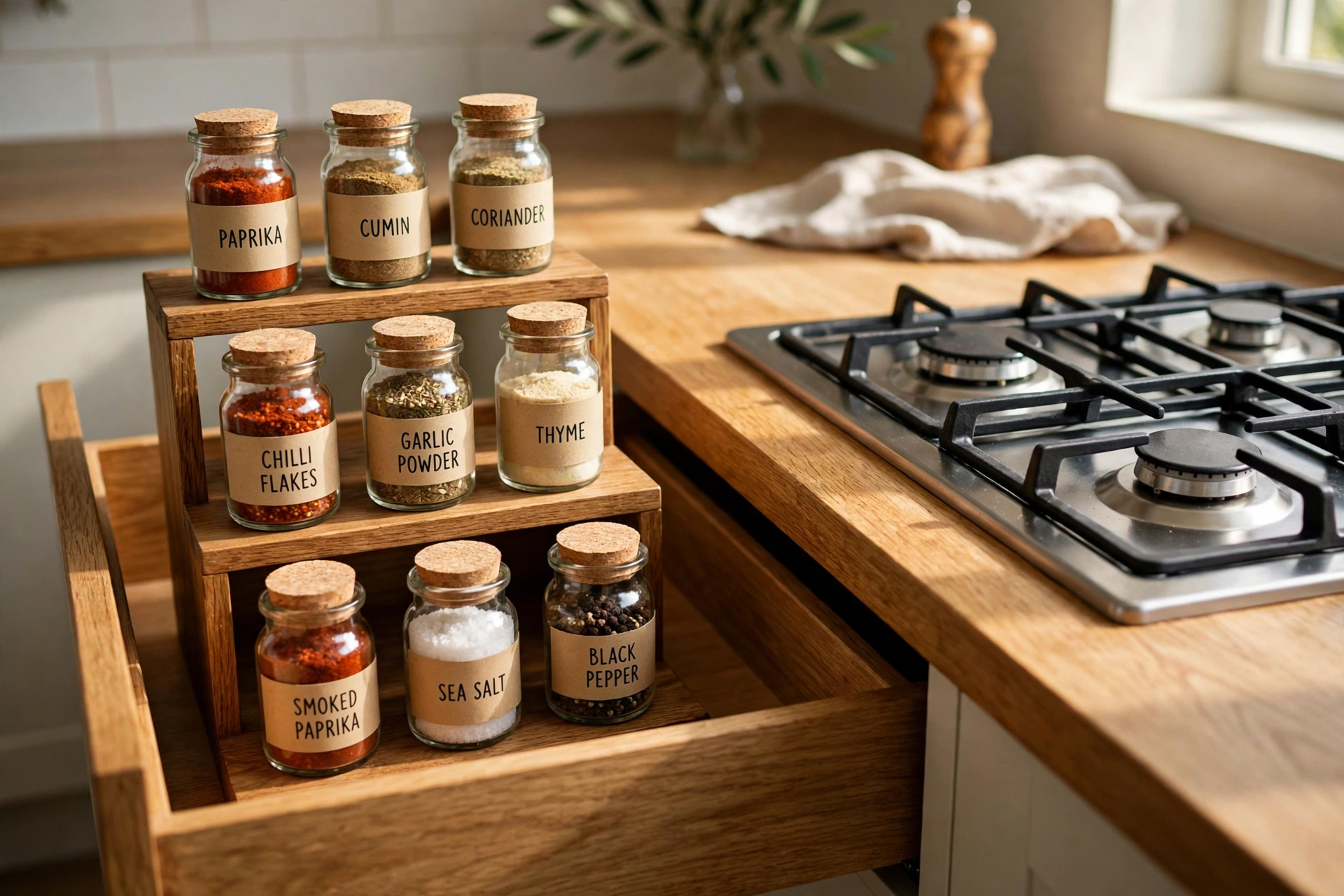
1. The tiered drawer insert beside the hob. An angled or stepped insert turns a standard drawer into a spice library you read at a glance, lids up, labels facing you. It is the single best system on this list if you have a drawer to spare near the cooking zone — the drawer logic in our kitchen drawer organization ideas guide starts from exactly this kind of insert.
2. The flat drawer with jars on their sides. No insert, no tiers: jars laid in rows, labels on the lids, read from above like a map. It wastes a little height and gains total visibility, and it costs nothing beyond a non-slip liner.
3. Two shallow drawers beat one deep one. If you are planning cabinets, specify two shallow drawers in the cooking run rather than one deep drawer and a prayer. Depth is the enemy named in the intro; shallow drawers make depth impossible.
Doors, Walls and Pull-Outs
4. Racks inside a cabinet door. Slim racks on the inside of a wall-cabinet door hold a single row of jars — the one-deep rule, using space that was doing nothing. Check the clearance against the shelves inside before screwing anything down; a rack that stops the door closing is a short-lived rack.
5. The narrow pull-out larder unit. Those 15-30cm pull-outs beside the hob were designed for exactly this: bottles and jars in single file, both sides reachable. If yours currently holds leaning trays and regret, evict them — spices are what it is for. Cabinet-wide systems sit in our kitchen cabinet organization ideas guide.
6. A magnetic wall or fridge-side strip. Matching tins on a magnetic rail keep spices visible, labelled and off the worktop. Keep them away from direct hob steam — the rail belongs on a side wall or the fridge flank, not in the splash zone.
7. The riser shelf inside the existing cupboard. If the cupboard must stay, a simple stepped riser turns its floor into stadium seating: back row visible over the front. It does not fix two-deep storage on the shelf above it, but it rescues the shelf it sits on for the price of a takeaway.
The System That Keeps It Working
8. Decant into one jar family. Mixed original packaging — bags, tubs, three brands of jar — is what makes a collection unreadable. One jar shape, one label style, everything decanted, and the drawer reads like print instead of noise. Refills live in the pantry, filed under the system in our kitchen pantry organization ideas guide.
9. Alphabetical, or by cuisine — pick one and commit. Alphabetical suits general cooks; grouping by cuisine (the Indian shelf, the baking row) suits specialists. Either works. What fails is the third system: wherever it landed last time.
10. Labels on the surface you actually see. Lids in drawers, fronts on shelves, tops in pull-outs. A labelling scheme that requires picking jars up to read them will be abandoned by February, and an abandoned scheme is just clutter with handwriting.
11. Keep the daily eight at the front. Most households use eight or so spices constantly and thirty occasionally. The daily eight live nearest the hob in the prime slot; the rest can accept a slightly longer reach. Organise by frequency, not by tidiness aesthetics.
12. Date them, and cull yearly. Ground spices fade in six to twelve months; whole spices last longer. A small date on the label’s underside when you decant, and one honest cull a year, keeps the collection a tool instead of a museum — and frees the space the next idea needs.