12 Kitchen Ceiling Ideas Most Renovations Forget Until Last
Ask anyone mid-renovation what their kitchen ceiling will be and you will usually get a pause. The ceiling is a quarter of the room’s surfaces, it decides how the light behaves, and it is the one thing that is genuinely hard to change afterwards. These 12 ideas put it back on the plan, where it belongs.
Structure You Can See
1. Real beams if the house has them — expose, don’t imitate. If original timbers are hiding above a lowered ceiling, uncovering them is the single biggest character gain a kitchen can get. Check for wiring and headroom first; a beam you duck under daily stops being charming by week two.
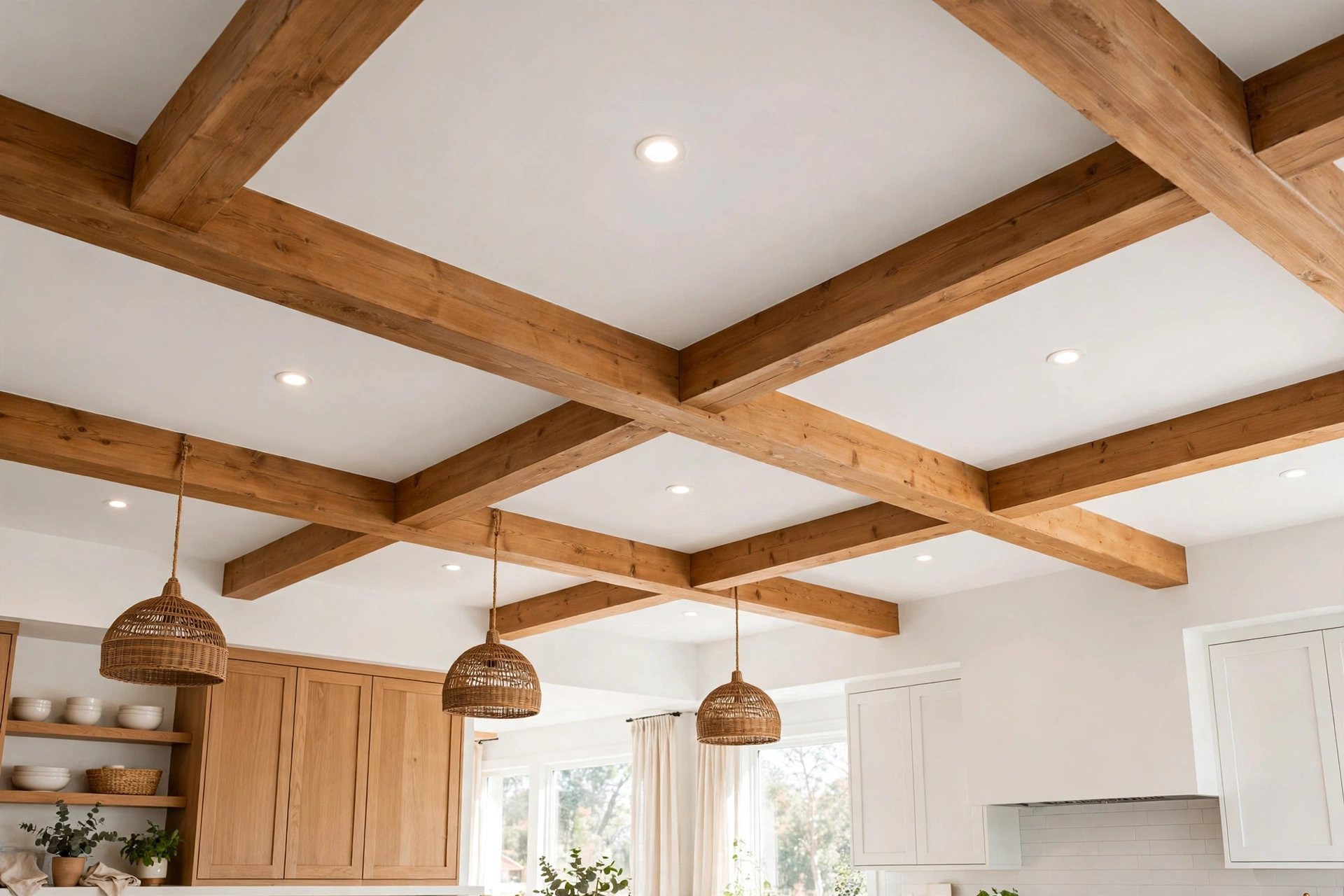
2. Faux beams where the ceiling is high and plain. Lightweight boxed beams in a kitchen over 2.7m add rhythm and a place to run cables. Rule: beams should run across the shorter span and land on walls or posts — beams that float mid-air fool nobody.
3. Tongue-and-groove for cottages and calm modern rooms alike. Painted boards add fine shadow lines that plain plaster cannot, hide a multitude of ceiling imperfections, and can be fitted over the existing ceiling. Run them along the room’s long axis to stretch it.
4. Coffers only where the height earns them. A coffered grid is beautiful at 3m and oppressive at 2.4m. In lower rooms, a single recessed tray over the island gives the same architecture without eating the air.
Colour and Surface
5. Colour-drench the ceiling in small, dark kitchens — carefully. Painting the ceiling the same colour as the cabinets removes the white lid that makes a small room feel like a box, and at night it is genuinely cosy. Test it on the north-facing reality, not the midday sample.
6. A warm white, never a blue white. Ceilings reflect light onto every face and plate in the room. A slightly warm white flatters food and skin; a brilliant blue-white makes both look ill. This matters more than the exact brand of paint.

7. Tin-look tiles for period homes and brave modern ones. Pressed panels — real tin or lightweight replicas — suit tall Victorian and Edwardian kitchens and take paint well. Keep them to the ceiling; tin on walls as well is a theme restaurant, not a home.
8. Limewash or a matte mineral finish where plaster is old. Uneven, historic ceilings look worse the flatter and shinier the paint. A soft mineral finish absorbs the bumps into texture instead of advertising them at every light change.
The Lighting Layer — Decided Before Plaster
9. Plan three circuits, not one. Recessed or surface spots for work, pendants for the island or table, and something low for evening — each on its own switch or dimmer. One circuit means the ceiling’s whole job is done at one brightness, which is wrong for at least two-thirds of the day, and it pairs with the task layer in our under-cabinet lighting ideas.
10. Spots in lines that follow the work, not a grid that follows the ceiling. A row over the worktop line and a row over the walkway beats a uniform grid that lights the middle of the floor beautifully and the counters not at all.
11. The extractor is a ceiling decision too. A ceiling-mounted or downdraft extractor frees the hob wall entirely, but its duct route, noise and grease path must be planned with the ceiling open — retrofitting one into a finished ceiling is the expensive way to learn this list.
Finishing Rules
12. Match the ceiling’s ambition to the floor’s. A heavily worked ceiling over a plain floor can feel top-heavy; pair beams or coffers with a floor that has some presence — pattern, plank width or colour — like the grounded options in our kitchen flooring ideas. Balance, not competition, is the goal.
Decide the ceiling while the room is still a building site: structure first, circuits second, colour last. It is the cheapest moment to give the kitchen its fifth wall — and the most expensive one to skip.