Kitchen Shelf Decor: 14 Ideas That Look Styled, Not Stuffed
A styled kitchen shelf and a stuffed one hold the same objects. The difference is a handful of rules: what goes where, how much empty space stays empty, and which three things repeat. These 14 ideas use those rules so your shelves look like a stylist arranged them — and still work every day.
The One-in-Three Rule
Every shelf should be roughly one third dishes, one third storage, one third decor. A shelf of all plates looks like a cupboard with no door. A shelf of all ornaments looks like a shop. Mix them and the shelf reads as a kitchen that happens to be beautiful. Leave a third of each shelf visibly empty, too — empty space is what makes the full parts look chosen.
Layering and Height
- Layer plates, tallest at the back. Lean plates in overlapping layers — a large plate behind, a medium one in front, a small bowl at the front edge. Two layers are enough; three starts to hide the back plate completely.
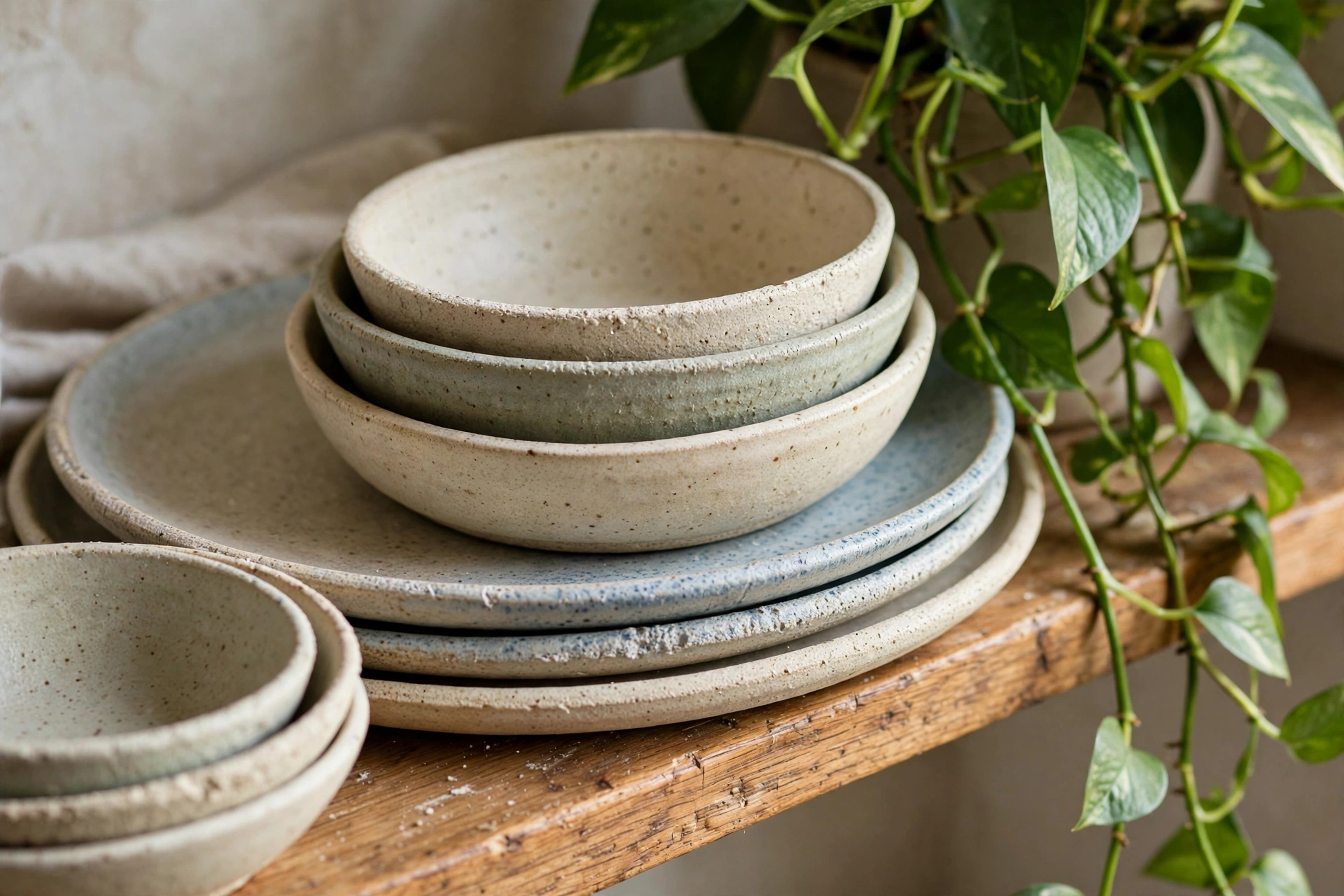
- Vary the heights on every shelf. A shelf where everything is the same height looks like a warehouse row. Mix a tall jug, a medium stack of bowls and a low plant, and the eye moves along the shelf instead of sliding off it.
- Stack bowls and plates in small piles. Two or three bowls stacked, two or three plates stacked, with space between the piles. Stacks are the one place where grouping identical items looks good — because the stack itself is one shape.
- Put the tallest item at one end, not the middle. A tall jug or vase at the left or right end anchors the shelf. Put it in the middle and it splits the shelf into two halves that never meet.
Plants, Books and Art
- One trailing plant per shelf run. A pothos trailing 20–30 cm over the shelf edge softens every hard line below it. One plant per run of shelves is enough — two plants on the same shelf compete and the shelf looks like a greenhouse.
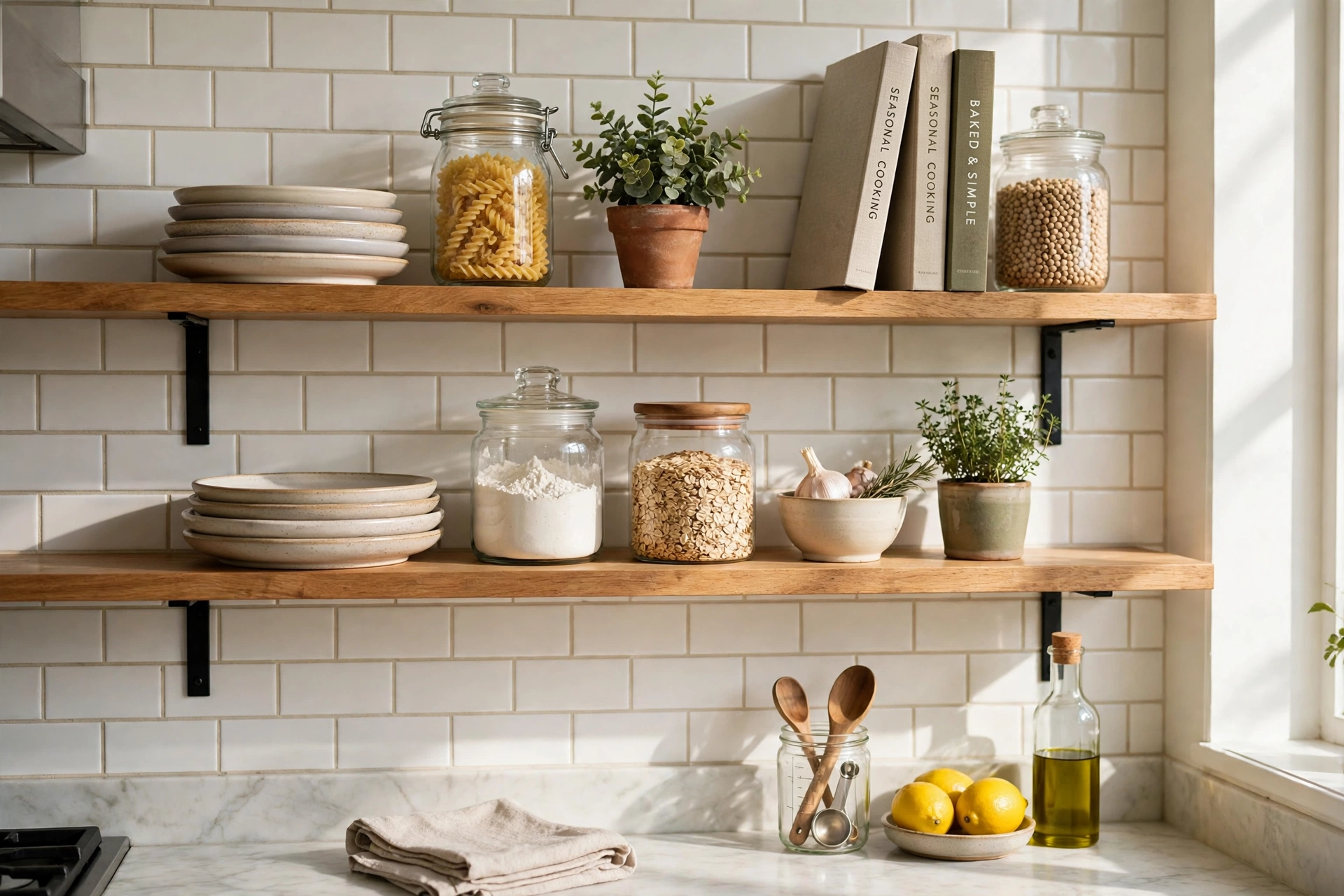
- Cookbooks stacked flat, spines showing one colour. Two or three cookbooks stacked horizontally make a plinth for a small plant or a candle. Keep the spines in one colour family; a rainbow of spines is the fastest way to make a shelf look busy.
- Lean one small framed print against the wall. A print no bigger than a chopping board, leaned rather than hung, adds a picture where a picture should not fit. Keep it at the back, behind the low items, so it reads as a backdrop.
- A candle or lantern for evening light. A simple lantern or a candle in a glass hurricane on the top shelf makes the kitchen glow in the evening. Never put a lit candle under a shelf above it — keep 15 cm of clear air above the flame.
Jars, Crocks and Everyday Items
- Glass jars for dry goods — same jars, same lids. Three matching glass jars of pasta, rice and flour are decor and storage at once. Mixed jars in different shapes and lids look like a pantry spill; matching jars look like a decision.
- A crock of wooden spoons by the hob end. One crock, five or six wooden spoons and spatulas, at the end of the shelf nearest the cooker. It is the most-used item on the shelf and the easiest to style — the wood repeats the shelf itself.

- Everyday mugs in one colour, hung or stacked. If mugs live on the shelf, keep them one colour. A row of mixed mugs is the single most cluttered sight in a kitchen; a row of matching mugs is a pattern.
- One metal accent — brass or copper, not both. A brass tray, a copper pot or a set of brass hooks gives the shelf a warm line. Pick one metal; brass and copper together argue on a small shelf.
The Finishing Rules
- Repeat one colour three times across the shelves. The colour of your splashback, your floor or your tea towels — repeat it in three places: a jug, a book spine, a plant pot. Three repeats make a scheme. One repeat looks accidental; five look forced.
- Edit ruthlessly, then leave it alone. Style the shelf, step back, and remove one thing. Then stop. Shelves that get restyled weekly never settle; shelves left alone for a season start to look like they belong.
Shelf Decor for a Small Kitchen
Small kitchens need shelves more than big ones — there is nowhere else for the daily dishes to go. The rules change slightly: fewer shelves, bigger items, and every shelf has to earn its place.
1. One shelf run only
In a small kitchen, one run of shelves above the worktop beats shelves on every wall. The rest stays cabinets. One run looks like a decision; shelves everywhere look like the cabinets gave up. Our small cozy kitchen ideas guide applies the same less-but-better rule to the whole room.
2. Use the wall above the sink
The wall above the sink is dead space — nothing you need while cooking lives there. A short shelf holds the soap, one plant and one mug. It is the one place a shelf can go without stealing worktop or cooking space.
3. Corner shelves
A small floating shelf in the corner uses space cabinets cannot reach. One shelf, two or three everyday items, and a corner that was empty becomes the prettiest spot in the kitchen.
4. Risers inside the shelf
A small step riser doubles the usable height of a shelf — mugs on the riser, bowls below it, and no wasted air. It is the cheapest way to fit more on one shelf without adding another one.
5. Hooks under the lowest shelf
Mugs hung on hooks under the lowest shelf free the shelf surface itself. The mugs are at grab height, the shelf above holds the plates, and nothing is stacked on anything else.
Seasonal Shelf Swaps: Four Small Changes a Year
Keep the base the same all year — the jars, the crock, the mugs. Swap three items per season, and the shelves always look fresh without ever being restyled from scratch.
Spring: a small vase with fresh stems and a light linen cloth. Summer: a bowl of lemons and a glass jug. Autumn: a small pumpkin, one amber glass and a few dried leaves. Winter: a candle lantern, pine sprigs and one red accent.
The rule is swap, never add — one item out for every item in, so the shelf never fills up. A shelf that gains one thing a season is a stuffed shelf by Christmas. For the surface below the shelves, our kitchen countertop decor ideas guide keeps the same seasonal rhythm on the worktop.
The 4 Mistakes That Make Shelves Look Stuffed
Filling every centimetre. A shelf with no empty space has nowhere for the eye to rest. Aim for a third empty. Everything the same height. Flat rows read as storage, not style — vary heights on every shelf. Five colours at once. One main colour, one wood tone, one metal. A fourth colour needs a reason. Decor you cannot reach past. If getting a plate means moving three ornaments, the ornaments will be resented within a week. Everyday items go at the front and at reach height; decor goes at the back and at the ends.
Costs at a Glance
Matching glass jars (3): $15–$30. Trailing plant + pot: $10–$25. Small framed print: $10–$20. Wooden crock + spoons: $15–$30. Brass tray or hooks: $12–$25. A full shelf run is styled well for $50–$100 — the jars and the plant are the best value in the list.
FAQ
How do I style shelves in a small kitchen? Use fewer, bigger items — three large things per shelf instead of nine small ones — and keep the bottom shelf for everyday dishes only. Our small kitchen storage ideas guide uses the same rule for the whole room.
Should shelves match the cabinets? They should repeat one thing from the room — the wood of the worktop, the metal of the taps, or one colour from the splashback. Matching the cabinets exactly is not required; repeating one element is.
How do I keep open shelves clean? Wipe them weekly with a damp cloth — five minutes for a run of shelves. Items you use daily stay clean on their own; the decor at the back needs the wipe. Glass jars with lids keep dust off dry goods entirely.
What should never go on a kitchen shelf? Anything you use less than once a month, anything heavy above head height, and anything that cannot be wiped clean. The shelf is a working surface, not an attic.
How many shelves does a kitchen need?
One run of two or three shelves is enough for most kitchens — daily dishes, one plant, one beautiful thing. More shelves mean more dusting and more temptation to fill them. If the shelves are full, the answer is fewer things, not more shelves.
Can I mix open shelves and closed cabinets?
Yes, and it is the best of both. Open shelves for the daily dishes and one beautiful thing, cabinets for everything else. The shelves show the kitchen at its best; the cabinets hide the rest.
For the wider shelf picture, see our kitchen open shelving ideas, and for the wall around your shelves, our kitchen wall decor ideas.
Style one shelf today: empty it, apply the one-in-three rule, vary the heights, repeat one colour three times, and remove one thing before you step back. That is the whole method — and it works on every shelf in the house.